💼 Summer 2026 at LinkedIn as an AI/ML Engineer Intern

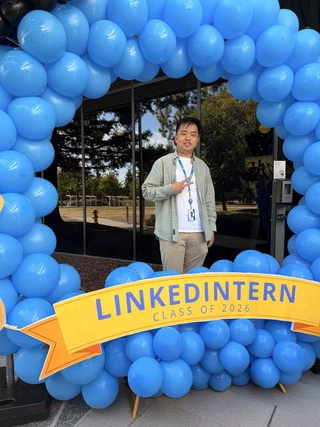 LinkedIn Intern, Class of 2026 — Mountain View, CA
This summer I joined LinkedIn in Mountain View, CA as an AI/ML Engineer intern on the Generative AI team, working on candidate retrieval for LinkedIn’s hiring assistant.
What I worked on
- Generative retrieval for hiring. I developed generative AI models for candidate retrieval, improving hiring recall by 46.4% and role fit by 33.3% in offline evaluation through reinforcement learning.
- The team’s first RL pipeline. I built the group’s first reinforcement-learning pipeline for candidate retrieval, using LLM-based rewards. To keep training fast, I created a candidate-profile lookup table that replaced per-step online requests and cut training latency.
- Constrained decoding. I implemented constrained decoding to prioritize candidates who are actively seeking jobs, increasing their share among retrieved candidates.
- Codebook evaluation. Alongside the retrieval work, I built an end-to-end pipeline for assessing training codebook quality for generative recruiting models — data checks, drift detection, and robustness analyses across cohorts and over time — and proposed a task-specific metric aligned to downstream hiring objectives such as match relevance and conversion propensity.
What I took away
Coming from a research background in LLM safety and unlearning, the biggest shift was how much of production ML is about evaluation infrastructure rather than modeling. A reward model is only as trustworthy as the offline evaluation you check it against, and most of the leverage came from making that evaluation faster and more honest.
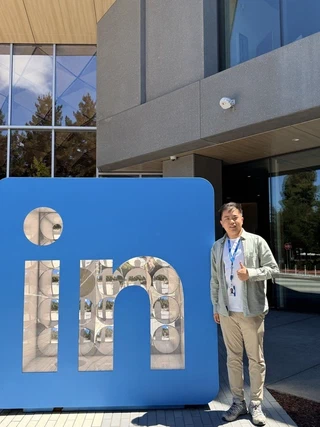
Thanks to my mentor and the whole team for a great summer.

I am a Ph.D. candidate in Computer Science at Wayne State University, advised by Prof. Dongxiao Zhu in the Trustworthy AI Lab. I work on making large language and reasoning models safe enough to deploy — specifically on machine unlearning, safety alignment, and robustness under adversarial or multi-turn conversation.
My AAAI-26 oral paper introduces Targeted Information Forgetting (TIF), which unlearns sensitive content at the token level rather than suppressing entire training samples, avoiding the utility collapse that over-forgetting causes. Related work spans adversarial in-context learning, membership-inference calibration, and attention-based unlearning.
In summer 2026 I was an AI/ML engineer intern on LinkedIn’s Generative AI team, where I built the group’s first reinforcement-learning pipeline for generative candidate retrieval, improving hiring recall by 46.4% in offline evaluation. I serve as a reviewer for AAAI, ICML, NeurIPS, and ICLR.
If you work on LLM safety, unlearning, or reasoning robustness, I would be glad to hear from you. 🚀