Not All Tokens Are Meant to Be Forgotten

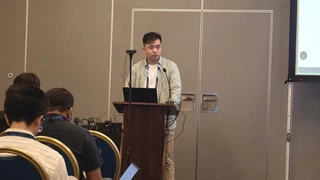 Presenting at AAAI-26, Singapore EXPO
Large language models memorize unwanted content — private, sensitive, or copyrighted — and existing unlearning methods suppress every token in a forget sample to remove it. That indiscriminate suppression causes over-forgetting: the model loses general capability along with the target.
In this talk I present Targeted Information Forgetting (TIF), which separates unwanted words (UW) from general words (GW) inside each forget sample, then applies Targeted Preference Optimization — a Logit Preference Loss that unlearns the UW, paired with a Preservation Loss that retains the GW. On the TOFU and MUSE benchmarks, TIF improves forget quality while preserving model utility, achieving state-of-the-art results.
Singapore EXPO
Singapore,
Our paper “Not All Tokens Are Meant to Be Forgotten” was accepted as an oral at AAAI-26 in Singapore. The work is joint with Yao Qiang, Saleh Zare Zade, Douglas Zytko, Prashant Khanduri, and my advisor Dongxiao Zhu, across Wayne State University, Oakland University, and the University of Michigan-Flint.
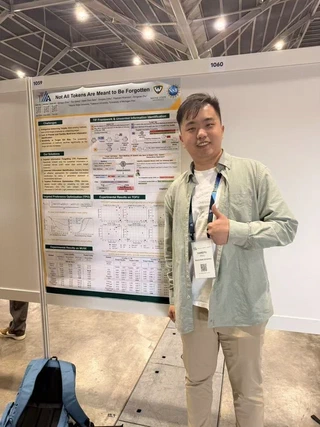

I am a Ph.D. candidate in Computer Science at Wayne State University, advised by Prof. Dongxiao Zhu in the Trustworthy AI Lab. I work on making large language and reasoning models safe enough to deploy — specifically on machine unlearning, safety alignment, and robustness under adversarial or multi-turn conversation.
My AAAI-26 oral paper introduces Targeted Information Forgetting (TIF), which unlearns sensitive content at the token level rather than suppressing entire training samples, avoiding the utility collapse that over-forgetting causes. Related work spans adversarial in-context learning, membership-inference calibration, and attention-based unlearning.
In summer 2026 I was an AI/ML engineer intern on LinkedIn’s Generative AI team, where I built the group’s first reinforcement-learning pipeline for generative candidate retrieval, improving hiring recall by 46.4% in offline evaluation. I serve as a reviewer for AAAI, ICML, NeurIPS, and ICLR.
If you work on LLM safety, unlearning, or reasoning robustness, I would be glad to hear from you. 🚀